

 Español


The first time you put on progressive glasses, the center of the lens looks sharp and the floor appears flat, but any quick glance to the side smears the world into a soft streak. It feels like a manufacturing fault, and many wearers return to the shop within a week asking the same question: why are progressive lenses blurry on the sides?
The short answer is that side blur is an optical property of every progressive lens, not a defect. A progressive lens cannot change its power from distance to near without creating zones of unwanted cylinder at the edges. The amount of blur you experience depends on the lens design, the add power, the frame, the fitting measurements, and how long you have been wearing the glasses. This article explains the mechanism behind side blur, separates normal blur from fitting problems, and shows the design decisions a lens manufacturer makes to keep the sides clearer.
Why the Sides of a Progressive Lens Are Never Completely Clear
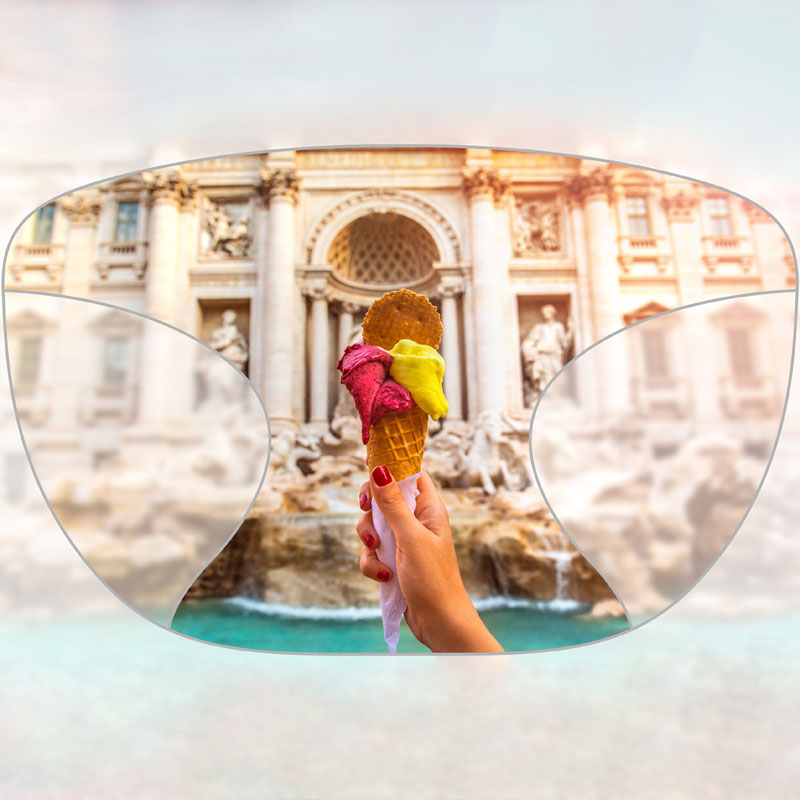
Side blur happens because a progressive lens is, in optical terms, a controlled compromise. Where the lens has to change power quickly, it also builds in unwanted cylinder power, and that cylinder is what turns straight edges into soft, smeared lines.
A progressive lens has three working zones: a distance zone at the top, a near or reading zone at the bottom, and a corridor that connects them. The corridor is a narrow vertical band in which the power gradually increases from the distance prescription to the reading add. The lens surface must curve more at the bottom than at the top, and that curvature changes continuously along the corridor.
This continuous change sounds elegant, but a surface that changes curvature rapidly also develops what opticians call oblique or unwanted astigmatism. In the areas on either side of the corridor, the surface becomes toric in a way that was never prescribed. Light passing through those zones is not focused into a single point; it forms two focal lines, and the eye receives a blurred image. That is the side blur you notice when you glance through the outer areas of the lens.
How much blur appears depends on several variables: the add power, the corridor length, the fitting height, and the frame size. It is not the same for every design or every prescription.
| Lens zone | Position | What the wearer sees | What causes it |
|---|---|---|---|
| Distance zone | Upper area | Clear distance vision | Full distance prescription is surfaced here |
| Corridor | Central vertical band | Smooth change from distance to near | Gradual power increase without cylinder |
| Near zone | Lower inner area | Clear reading vision | Reading add power shaped for near work |
| Peripheral zones | Outer areas beside the corridor | Blur, swimming, mild distortion | Unwanted astigmatism from rapid surface curvature change |
Designers also talk about hard and soft aberration management. A hard design concentrates the unwanted astigmatism into a thin lateral band, so the corridor feels wide and the near zone is wide, but the border between clear and blurred is abrupt and you sense a “swim” when moving your head. A soft design spreads the aberration over a larger area; the edge of the lens is less suddenly sharp but never fully clean. Most modern digital designs try to find a balance between these two approaches.
 All Purpose Progressive Lens for Everyday Vision NeedsThis customized progressive lens balances hard and soft designs, offering clear distance, intermediate, and near vision across a wide range of prescriptions and fitting heights.View Product →
Lens Design Factors That Control the Amount of Side Blur
The progressive design is the single biggest factor in how much side blur you experience. Within the same prescription, two different designs can reduce the blur from “distracting” to “hardly noticed,” or the opposite. A generic progressive lens uses a pre-calculated surface that is identical for a wide range of wearers. That surface cannot adapt to your fitting height, your eye convergence, your frame wrap, or the axis of your astigmatism. A freeform design, by contrast, is computed point by point for one pair of eyes and one frame.
Four design-related factors should be understood before choosing a lens:
- Corridor width: a wider corridor is more comfortable for daily wear, but it uses up optical area that could otherwise soften the lateral aberration. Narrower corridors create more noticeable edge blur.
- Corridor length: long corridors soften the power transition and produce less concentrated aberration, but they need a larger fitting height. Short corridors fit small frames but increase side blur.
- Add power: the higher the reading add, the more unwanted astigmatism the edges contain. A +1.00 add has modest side blur; a +2.50 add has considerably more.
- Material and index: a thinner high-index lens reduces magnification differences, which can make the sides feel calmer, but high-index materials have lower Abbe values and may add color fringing at high adds. The design choice matters more than the index.
| Design tier | Surface computation | Corridor behaviour | Side blur | Best suited to |
|---|---|---|---|---|
| Entry / stock progressive | Pre-calculated curves for limited ranges | Fixed corridor, average width | Moderate to noticeable | First-time wearers with simple prescriptions |
| Premium stock progressive | Optimised for a prescription category | Wider corridor, softened lateral zones | Lower and more balanced | General daily use and long screen hours |
| Freeform personalised progressive | Point-by-point computation for the wearer | Corridor matched to frame and eye position | Minimised and shifted away from the main gaze | High adds, astigmatism, unusual fitting heights |
For most wearers, a well-balanced general-purpose design is the right starting point for office, shopping, and driving. The all-purpose progressive lens in our Everyday progressive family uses a wider corridor profile that keeps peripheral blur visible but manageable, and it works well with the most common frame sizes. If the prescription is straightforward and the fitting height is normal, this kind of design removes most of the “hard edge” that new wearers complain about.
Fitting Errors That Make Side Blur Worse
If the lens design is correct but the fitting is wrong, the progressive corridor no longer sits where the eye actually looks, and peripheral blur increases on one side or appears in the wrong part of the lens. In other words, a good lens can feel like a bad one when the frame is not measured correctly.
The most common measurement faults that amplify side blur are:
- Incorrect pupillary distance: an error of more than 1 mm in the monocular PD shifts the corridor sideways. One eye then receives more of the lateral aberration while the other sees the corridor displaced, creating asymmetrical blur.
- Fitting height too low: if the corridor is compressed because the fitting cross sits below the pupil, the peripheral aberration zones expand vertically and the sides feel more distorted. Most designs require a minimum fitting height of 14 to 16 mm.
- Pantoscopic tilt and frame wrap: a progressive surface is calculated for an expected tilt, usually around 8 to 10 degrees. If the frame is adjusted flatter or more wrapped, the distance and intermediate power zones shift and the lateral blur moves into the main gaze.
- Vertex distance: when the lens sits farther from the eye than the design assumed, the effective power at the periphery changes, which increases the feeling of swim and edge distortion.
- Frame shape: small frames with high wrap restrict eye movement and force the wearer to scan through the peripheral zones instead of moving the head, making normal design blur more noticeable.
Fitting checklist to run through before blaming the lens:
- Fitting cross centred over the pupil at natural head posture
- Monocular PD measured, not only binocular PD
- Fitting height at least 14–16 mm depending on the design
- Pantoscopic tilt close to 8–10 degrees
- Frame wrap and vertex distance close to the design assumption
- Right and left fitting heights matched
Because progressive lenses are manufactured with visible or hidden engravings, an experienced fitter can verify the corridor position after cutting. The engraved fitting cross on our stock and freeform lenses is the reference point for this check. If the blur is stronger on one side only, the most likely explanation is a PD or horizontal alignment error, not the design itself.
New wearers also ask whether they must keep the glasses on all day during the adjustment period. This guide to all-day progressive wear explains why consistent use helps the brain adapt faster and reduces the impression that the sides are permanently blurred.
 Relax 2.0 Progressive Lens to Prevent Eye StrainDesigned for non-presbyopic wearers, this lens reduces tiredness from prolonged near work, with minimal add powers and a 14mm corridor for comfortable use.View Product →
Adaptation: Why the Blur Fades After a Few Weeks
Most side blur fades within two to three weeks, not because the lens changes but because the brain learns to ignore the peripheral aberration and to aim the nose at what the eyes want to look at. This is a normal neurological process, not a sign that the lens has improved.
In a single-vision lens, the eyes can scan the whole lens freely because every point has the same power. A progressive lens asks the wearer to change that behaviour: the eyes must learn that the corridor is the only clean path between distance and near, and that moving the head instead of the eyes keeps objects inside that path. As the brain builds this new eye-head coordination, the side blur becomes less distracting even though the optics have not changed.
Perceived side blur during the first four weeks of wear
Practical tips that shorten the adaptation period:
- Start wearing the glasses as soon as you wake up, before the brain falls back into old eye movement habits.
- Point your nose at the object of regard; let the eyes use the corridor instead of searching with wide eye movements.
- When reading, move the page or your head slightly instead of rolling the eyes far downward into the near zone.
- Take extra care on stairs during the first days; the peripheral distortion makes the floor appear to move, but that sensation settles quickly.
- Avoid switching continuously between the new progressive pair and an old single-vision pair, because the back-and-forth extends the adaptation period.
Some wearers are particularly sensitive to the lateral power gradient during this learning phase. Lenses designed with a milder transition, such as the Relax 2 progressive design in our lifestyle family, hold off the sharpest power change until later in the corridor, so the sides feel less aggressive in the first weeks. This type of lens is useful for new presbyopes who find standard progressives too sudden.
Progressive Design Families and the Side-Blur Tradeoff
Because side blur is a design tradeoff rather than a fixed defect, a manufacturer can offer several progressive families, each with a different corridor geometry to match how and where the glasses are used. The practical conclusion is that the lens should be selected for the wearer’s daily visual tasks, not just for the prescription.
All-Purpose Progressive
Balanced corridor for distance, computer, and reading. The standard choice for everyday wearers. Side blur is moderate, predictable, and easy to adapt to.
Deluxe Progressive
Wider reading area and a softer lateral gradient. Requires a frame with enough fitting height, but rewards the wearer with a larger clear near zone.
Dynamic Progressive
Built for active lifestyles and frequent focus changes. Intermediate power increases earlier, giving steadier vision at mid-distances with less swim when moving the head.
Occupational Progressive
Near and intermediate oriented for screen work and reading. Lateral zones are redistributed so peripheral blur has less effect during close work.
The everyday family suits the broadest range of wearers because the corridor is positioned for general use rather than a single task. The lifestyle family, which includes driver and junior designs, adjusts the corridor height and inset for specific activities such as driving or learning. The occupational family, including Desk 2, Office, and Professional 2, moves the corridor lower and widens the near area, which changes where the side blur appears: less at desk height, more at the top of the lens.
For wearers with high astigmatism, strong adds, or unusual fitting heights, standard progressives leave too much residual blur in the periphery. The solution is a point-by-point computed freeform design, which the Optotech series uses. What makes Optotech progressive lenses different from standard lenses is that the surface is calculated for the actual frame, fitting height, and eye position, so unwanted astigmatism can be placed where the eye rarely looks, deep in the lower corners, instead of exactly beside the corridor. The result is a flatter, less distracting lateral view for difficult prescriptions.
 Opto Tech HD Progressive Lens for Difficult PrescriptionsA hard freeform design that concentrates peripheral blur for high astigmatism and strong adds, ideal for driving and outdoor use with customized fitting options.View Product →
What a Lens Manufacturer Does to Reduce Side Blur
From a manufacturer’s perspective, side blur can be controlled at three stages: design optimisation, surface generation, and quality verification. The lens can be improved before it is even cut for a frame.
At the design stage, optical engineers take the prescription and fitting parameters and compute a progressive surface. The optimisation program balances corridor smoothness, near zone width, and aberration placement. The goal is not to remove all peripheral astigmatism, which is physically impossible, but to spread it into regions of the lens that the wearer passes through quickly rather than looks through steadily.
At the surface generation stage, freeform lenses are produced with precision CNC machining in our own facility; the back surface is computed independently for each order instead of being moulded from a fixed curve. That freedom is what allows a high-add prescription to keep an acceptable corridor width while pushing the residual blur outward. For stock progressive lenses, the progressive surface is moulded from a master mould and the design logic is the same, but it cannot be personalised to the same degree.
At the quality verification stage, every lens passes automated inspection. Power is measured at multiple points along the corridor, and the engraved markings confirm that the corridor sits exactly where the fitter expects it. Surface defects, coating drops, or polishing marks would create local blur that is entirely different from progressive aberration, and these faults are rejected before shipping. Production follows ISO 9001 and ISO 14001, and the product range is registered with CE and FDA, which for the end wearer means consistent surface quality and a predictable side vision experience.
An example of this engineering approach is the Optotech HD progressive design. It is computed point by point to distribute aberration more evenly across the periphery, reducing the hard edge of the blur and keeping the corridor wide enough for comfortable eye movement. Wearers with moderate to high adds typically report that the sides feel softer and that the head-turn habit becomes natural more quickly.
When Side Blur Signals a Real Problem
Most side blur is a normal part of progressive optics, but some blur patterns mean something is wrong. The practical rule is this: if central vision is sharp and the blur only appears in the far periphery when the eye turns, that is normal. If the blur sits in the middle of the lens, appears on only one side, or brings persistent headaches after two weeks, the likely causes are the fitting, the prescription, or the frame, not the progressive concept itself.
| Symptom | Likely cause | Action |
|---|---|---|
| Blur only at the extreme edges | Normal progressive aberration | Continue adaptation; move the head instead of scanning with the eyes |
| Blur on one side only | Monocular PD error or tilted frame | Re-measure PD and re-check frame adjustment |
| Blur in the central distance area | Power or cylinder error | Re-verify the prescription and the base curve |
| Blur worse when walking or moving | Corridor too short for fitting height | Choose a longer-corridor design or a larger frame |
| Constant headache by weeks 2–3 | Vertical imbalance or prism error | Re-measure fitting heights and prism |
| Wavy distortion on flat surfaces | Base curve or asphericity mismatch | Re-select the lens base curve for the prescription |
Any lens with visible coating defects, surface waves, or cracks should be replaced immediately. These problems produce a localised blur or glare that has nothing to do with progressive design. Similarly, if a previous progressive pair was comfortable and a new pair with the same prescription suddenly shows strong side blur, the first suspects are the new frame’s fitting height and wrap angle, not the lens type.
Frequently Asked Questions
Is it normal for progressive lenses to be blurry at the sides?
Yes. The peripheral zones of every progressive lens contain unwanted astigmatism by design. Blur at the extreme sides when glancing through the lens is expected and is part of the reason why head movement matters with progressives.
How long does the side blur last?
Most wearers adapt within two to three weeks. The brain learns to turn the head instead of scanning with the eyes. If the blur still dominates daily vision after three weeks, the fitting should be checked before anything else.
Do more expensive progressive lenses have less side blur?
Usually, but the price is not the direct cause. More expensive designs are typically personalised: the surface is computed for the actual frame, fitting height, and eye position. That personalisation is what moves the residual aberration away from the main visual path.
Can progressive lenses be made without side blur at all?
No. The power gradient physically requires some unwanted cylinder. The goal of modern design and freeform surfacing is to place that aberration where the eye rarely looks, not to remove it completely.
Does a higher refractive index reduce the side blur?
A thinner lens reduces magnification differences, which can make the sides feel calmer, but high-index materials have lower Abbe values and can increase colour fringing. The design choice affects side blur more than the material index does.
Should I move my eyes or my head to avoid peripheral blur?
Both. Use normal eye movement for small shifts of a few degrees, but turn your head toward anything you want to inspect closely. This keeps the object inside the corridor, where the optics are clean.