

 Español


A 63-year-old machinist picks up his first pair of progressive lenses. Two weeks later he comes back with a strange complaint: straight ahead, everything is crisp, but every time he tips his head back to read a dial above his bench, the floor seems to tilt and he feels briefly unsteady. His prescription is ordinary, the lenses are not defective, and the frame is a normal size. The design simply places optical distortion exactly where his job forces him to look.
That is the honest core of the question "who should not wear progressive glasses?" Progressive lenses remain the most practical single pair for most people with presbyopia, and they are the wrong first choice for a small but clearly identifiable set of wearers. In most of those cases the wearer is not the problem. The lens design, the frame, or the working distance is the problem, and each can be changed.
Here is the short verdict before the reasoning. The six groups below are the ones who should be offered an alternative first, or at least warned properly before they buy.
1. Overhead and off-center work
Electricians, ceiling installers, painters, aircraft mechanics and anyone on a lift spends the day looking up or sideways. The top of a progressive lens carries distance power only, so near tasks above eye level fall into the wrong zone.
2. Balance and neurological conditions
Vestibular disorders, stroke recovery, Parkinson's, traumatic brain injury and reduced contrast sensitivity make the peripheral swim of a progressive lens a genuine safety issue rather than an annoyance.
3. Large differences between the two eyes
Anisometropia beyond roughly 1.00 D, high oblique cylinder, ptosis, amblyopia or single-eye vision break the binocular teamwork that hides induced prism at reading level.
4. Fixed wide-field professionals
Surgeons, dentists, microscopists, machine operators, crane drivers and some professional drivers need one wide, stable field at a set distance, not three zones that must be hunted for.
5. Children and teenagers
Young eyes still accommodate freely. Myopia control relies on peripheral defocus designs, and a progressive add produces only a small, often unmeasurable benefit for most children.
6. Repeat non-adapters
Two failed attempts with correct measurements usually mean the design family is wrong for that wearer, not that the wearer is difficult.
The Optics Behind These Exclusions
A progressive lens is a lens whose power changes continuously. The distance prescription sits at the top, and the plus power for near work increases gradually down a narrow corridor until it reaches the full reading addition at the bottom. Because a single surface cannot deliver every power everywhere, the areas to the left and right of that corridor carry unwanted astigmatism, commonly somewhere between 0.50 D and more than 2.00 D depending on the addition and the design family.
That residual astigmatism is what wearers describe as swim, wobble or a soft edge. It is not a manufacturing fault; it is geometry. A useful comparison for anxious first-time wearers is that a progressive lens redistributes clarity instead of multiplying it.
Three numbers explain most failures. The first is corridor width at the near zone, often only 10 to 20 mm on a standard design. The second is the addition power: above roughly +2.50 D the corridor narrows further and peripheral blur increases. The third is fitting height, because a lens placed 2 mm too low loses part of the reading zone entirely, while a lens placed too high makes the wearer feel as if the ground is rising. Understanding these three variables is what makes the difference between a genuine "should not wear progressives" case and a lens that was simply positioned badly.
| Design | Distance field | Intermediate | Near zone | Peripheral distortion | Typical best use |
|---|---|---|---|---|---|
| Single vision | Wide and stable | None | None | Very low | One fixed working distance, safety eyewear, high cylinder |
| Flat-top bifocal | Wide and stable | None, with a visible jump at the line | 22 to 28 mm wide | Low above the segment | Overhead work, cost-sensitive wearers, prism needs |
| Standard progressive | Wide at the top | Narrow corridor | 10 to 20 mm wide | Moderate to high | General all-day wear with normal posture |
| Occupational or office design | Limited, roughly 2 to 4 m | Very wide | Wide | Low | Desks, screens and tasks between 40 and 100 cm |
| Custom freeform progressive | Fitted to the frame | Tunable | Tunable | Reduced for the same addition | High additions, unusual fitting geometry, demanding wearers |
Commonly reported reasons for progressive lens non-adaptation
Illustrative summary of recurring dispensing patterns rather than a single published study. Individual practice data will differ.
If you want the background on why the design exists in the first place, the site's overview of why people need progressive lenses sets out the presbyopia basics clearly.
1. People Who Work Above Eye Level or Off-Center
Anyone whose job places the task above the head or far to the side is working outside the design brief of a progressive lens. Consider a ceiling installer drilling anchors above shoulder height, an electrician terminating cables in an overhead tray, a mechanic checking a component from below a lift, or a warehouse picker reading labels on a top shelf. In each case the eyes must converge on a close object while the line of sight points upward, and the upper part of a progressive lens offers distance power only.
Fixed head posture and limited neck movement
Reading through a progressive corridor requires about 8 to 12 degrees of downward eye rotation plus a degree of head movement. Wearers with cervical spondylosis, fused vertebrae, a neck brace, torticollis, or a job that forces the head to stay level lose that option. A welder inside a helmet, a dentist with both hands in a patient's mouth and a camera operator behind a fixed eyepiece all belong in this group. When the head cannot move, the lens must do the work, and a progressive lens is the wrong tool for that.
What works instead
- Flat-top bifocals, which keep the upper field completely stable and place a wide reading segment where the wearer can find it instantly.
- Single vision glasses set for the actual task distance, whether that is 50 cm overhead or 70 cm at arm's length.
- Two pairs of single vision glasses, one for distance and one for the task, which costs less than a remake and eliminates the complaint.
- Safety eyewear built to the relevant standard, with sufficient vertical depth in the frame to hold the reading segment.
2. People With Balance, Vestibular, or Neurological Conditions
This is the group where "not ideal" becomes "not advisable". Peripheral distortion is tolerable for a healthy 50-year-old with good contrast sensitivity and fast visual processing. For a wearer with a vestibular disorder such as BPPV, vestibular neuritis or Meniere's disease, the same distortion can layer on top of an existing sense of instability.
The same caution applies to people recovering from a stroke, people with Parkinson's disease, multiple sclerosis, traumatic brain injury, nystagmus, hemianopia, or significant diabetic retinopathy. Older wearers with reduced contrast sensitivity are also more affected, because the visual system relies more heavily on peripheral motion cues for balance the older it gets.
What the falls research suggests
Randomized work in older adults has found that switching habitual multifocal wearers to single vision distance glasses for outdoor walking reduced falls. The reasons are not complicated: multifocals blur the lower peripheral field, which is exactly the field used to judge steps, curbs and uneven ground. That does not mean every older wearer must abandon progressives. It means the recommendation should be individualized, and it means the first two weeks should never overlap with ladder work, unfamiliar stairs or night driving on wet roads.
Practical middle ground
- Keep a separate single vision pair for walking outdoors, stairs and exercise.
- Ask for a shorter corridor with a slightly reduced addition where the prescription allows it, which widens the usable area.
- Delay the switch during an active episode of vertigo, then reintroduce the lenses gradually with full-time wear rather than occasional wear.
- Confirm that any prism in the prescription is correctly incorporated rather than left out.
3. People With Large Differences Between the Two Eyes
Binocular vision quietly solves a lot of problems. When the two eyes carry very different prescriptions, that teamwork breaks down at reading level and the wearer notices it immediately in a progressive lens.
The mechanism is induced prism. When the eyes rotate down to the near zone, they look through a point well below the distance optical center. The vertical prism induced at that point is the power difference between the eyes multiplied by the decentration in centimeters. A wearer with a 2.00 D difference between the right and left eye, reading 8 mm below the distance reference point, experiences about 1.6 prism diopters of vertical imbalance. Many people begin to notice problems above roughly 1.0 to 1.5 diopters, and the symptoms are headache, a pulling sensation, double vision at near, and a strong preference for closing one eye.
Several related situations deserve the same caution:
- High oblique cylinder, especially above 2.00 D, where the distortion of a progressive corridor compounds the distortion of the astigmatic correction.
- Ptosis or heavy upper eyelids, which physically drop into the corridor and cut off the reading zone.
- Amblyopia, monocular vision, or a large difference in visual acuity between the eyes, where there is no second image for the brain to fuse and suppress.
- Prescriptions requiring a fixed prism, which can be incorporated into a progressive but limits design choice and often works better in a bifocal or single vision lens.
- Post-surgical situations such as monovision after cataract surgery, where the two eyes are deliberately set for different distances.
For this group the alternatives are straightforward and usually cheaper: single vision lenses for distance and a separate reading pair, flat-top bifocals, or contact lenses. Where no binocular coordination exists, one clear zone per pair beats three compromised zones in one lens.
4. Professionals Who Need One Wide, Undistorted Field
Some occupations do not tolerate a design that requires the wearer to aim the lens. A surgeon working at 40 cm through loupes, a dentist at 35 cm, a microscopist with both eyes locked to an eyepiece, an assembly line inspector scanning a fixed plane, a crane operator reading a load indicator at 3 m: all of them need one wide, uniform field at a single distance.
Driving deserves special attention
Driving is a compound task. The instrument cluster sits roughly 60 to 80 cm away, the road and the mirrors sit much further, and at night a dilated pupil passes more of the peripheral distortion of the lens. Wearers with a high addition frequently report that street signs stay sharp while the dashboard and the mirror edges go soft, or that headlights produce extra streaks and halos that they never noticed with single vision lenses. The extra glare is partly the lens material and its coating, and partly the aberrations that appear when the eye looks away from the corridor.
For frequent night drivers, a dedicated pair used only for the car makes a measurable difference, because the design can be tuned to the driving geometry instead of compromised between a desk and a road.
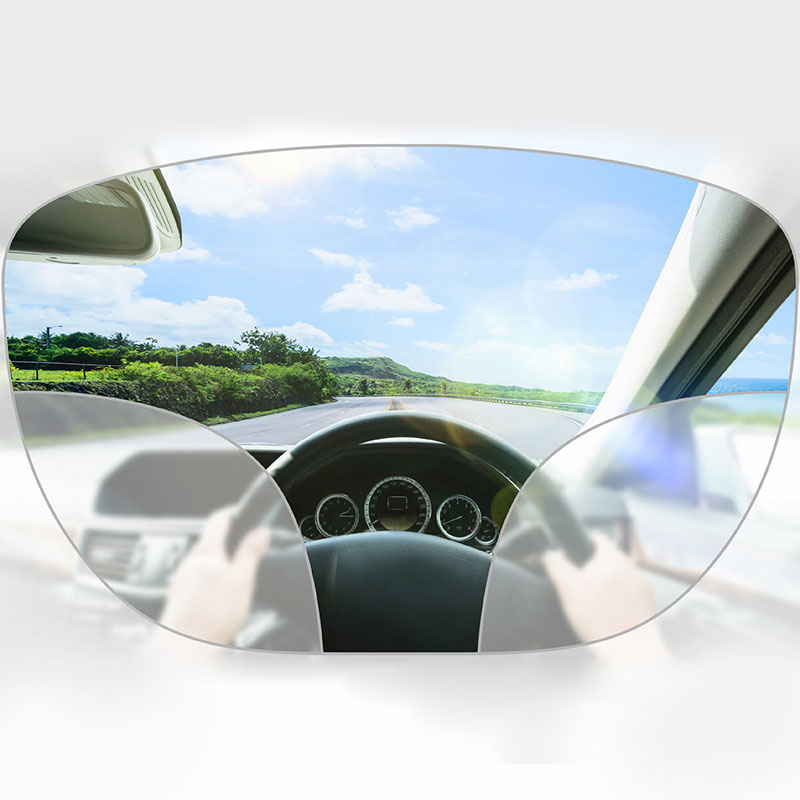 Driver Progressive LensThe Custom Driver is a progressive design that includes a wide distance area for comfortable viewing across the full width of the windscreen. The intermediate area is ...View Product →
Who else belongs here
- Pilots and air traffic controllers who must read instruments and distance simultaneously with reliable peripheral awareness.
- Machine operators and forklift drivers working in aisles with pedestrians.
- Competitive shooters, golfers, cyclists and racquet sports players who rely on peripheral motion detection.
- Musicians reading a score at 60 cm while watching a conductor in the distance.
For most of these wearers a task-specific pair, an occupational design, or simply single vision distance lenses with a separate reading pair solves the complaint in a single visit.
5. Children and Teenagers
Children rarely need progressive lenses, and the reason is anatomical. A healthy eight-year-old has an accommodative amplitude of roughly 14 diopters; even a young adult retains about 10. Near vision is not the bottleneck, so adding a progressive corridor solves a problem the child does not have.
There are narrow exceptions. Progressive additions are occasionally used for accommodative esotropia with a high accommodative convergence to accommodation ratio, for convergence excess, for accommodative insufficiency that has not responded to vision therapy, and for post-concussion visual symptoms in teenagers. Even in those cases a flat-top bifocal often works as well, costs less, and is easier to explain to a school-age wearer.
Myopia control is a different product category
Parents frequently ask whether progressive lenses will slow their child's myopia. The evidence is modest. The well-known COMET trial found that progressive addition lenses slowed progression by only around 0.20 D over three years, which is not clinically decisive for most children. The designs that carry meaningful evidence today use peripheral defocus or defocus incorporated multiple segments, orthokeratology, and low-dose atropine, often in combination. Progressive additions are not the same thing, and presenting them as equivalent is a common and avoidable misunderstanding.
Practical issues matter too. Children's frames are often 26 to 30 mm deep, which leaves no room for a proper corridor, and children lead active lives that demand impact-resistant material. Polycarbonate at 1.59 index with a hard coat remains a sensible default for that group. When a child genuinely needs an add, a bifocal in a sturdy frame usually outperforms a progressive.
6. Repeat Non-Adapters
Non-adaptation is less common than the internet suggests, but it is real. Most first-time wearers settle within one to two weeks of full-time wear. Published figures for genuine non-adaptation generally sit somewhere between 3 and 10 percent depending on the population and the design studied, with higher rates among first-time wearers given a high addition in a small frame.
The distinction that matters is between a fitting error and a genuine design mismatch. If symptoms persist beyond three or four weeks of consistent wear, and the fitting height, monocular pupillary distances, pantoscopic tilt and vertex distance have all been verified, the wearer is very likely a true non-adapter rather than an impatient one.
What to do on the second attempt
- Do not repeat the identical design, corridor length and material. Something has to change.
- Move to a shorter corridor, a lower addition where the prescription permits, or a different design family with a softer peripheral profile.
- Try a flat-top bifocal. Many people who cannot tolerate progressives adapt to bifocals within days.
- Consider a two-pair solution: single vision distance plus single vision near. It is often the cheapest route to a satisfied wearer.
- Recheck the binocular balance and any anisometropia before blaming the lens.
Wearers who describe headache only at a specific gaze angle, or who say the correction feels fine indoors but wrong outdoors, are usually describing a fitting or geometry issue rather than an inability to adapt. That is worth one more careful measurement before an expensive restart.
What to Wear Instead, by Scenario
Most of the exclusions above have a practical substitute. The table below maps the situation to the design that usually performs better, based on the working distance and the posture involved rather than on price.
| Situation | Avoid as the first choice | Better option |
|---|---|---|
| Overhead work, ladders, scaffolding | Standard progressive | Flat-top bifocal or single vision task glasses |
| Desk and screen work at 40 to 100 cm | High addition progressive | Wide-intermediate occupational design |
| Frequent night driving | High addition progressive | Dedicated driving design or distance single vision |
| Vestibular disorder or high fall risk | Any multifocal for outdoor walking | Two single vision pairs |
| Anisometropia above 1.50 D | Standard progressive | Single vision, bifocal, or contact lenses |
| Child with convergence excess | Progressive addition | Bifocal plus binocular management |
For screen-heavy wearers, an occupational design with a wide intermediate zone reduces the constant head tilting that a general progressive encourages. The working range is deliberately limited to roughly 40 to 100 cm, which is exactly what a desk, a laptop and a second monitor require.
 Office Occupational LensAn excellent lens to wear while working at tasks requiring near and intermediate vision. The design has a wider field of view and more comfortable posture than a fully...View Product →
For wearers who need a stable upper field and an unmistakable reading segment, a flat-top bifocal remains one of the most reliable corrections ever made. It has a visible line and no intermediate zone, and both of those traits are advantages for a specific group of people rather than defects.
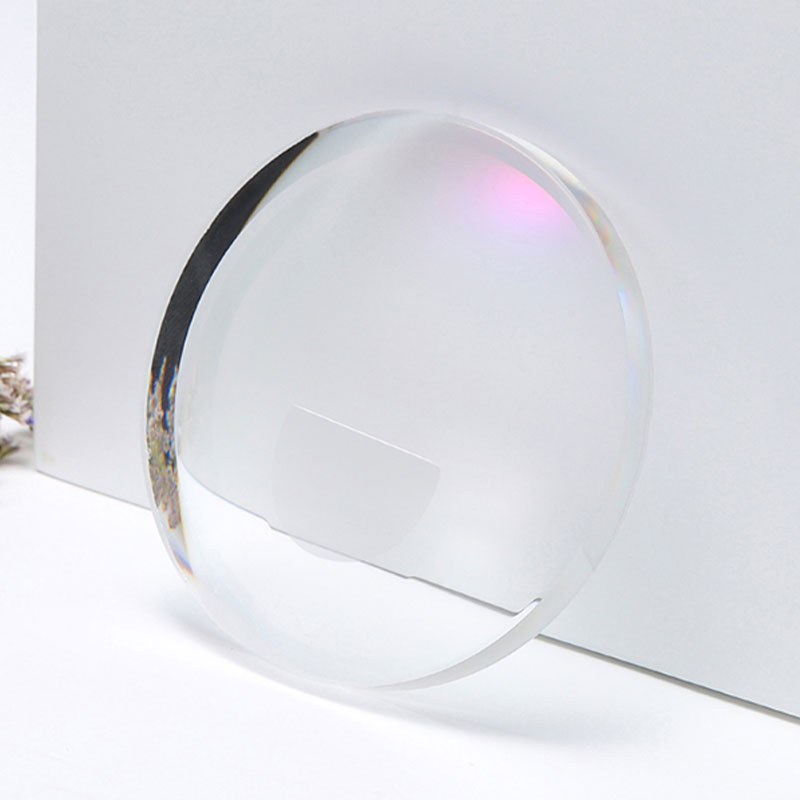 1.56 Bifocal Flat-Top Lens HMCWhen a person loses the ability to naturally change the focus of eyes due to age,you need to look at far and near vision for vision correction respectively, and often ...View Product →
A two-pair strategy also deserves a mention for practical reasons. Handing a wearer a distance pair and a near pair removes the adaptation curve entirely, gives both lenses a wide clean field, and often costs less than a premium custom progressive plus a remake.
Fitting and Measurement: Turning a No Into a Yes
Before concluding that a wearer should not use progressive lenses, it is worth confirming that the lens was given a fair chance. A large share of "I cannot wear progressives" cases turn out to be measurable geometry problems, and the site's breakdown of the five common reasons progressive lenses feel blurry covers several of them in detail.
The numbers that decide success are not secret:
- Fitting height. Short corridors commonly need a minimum of 14 mm, standard corridors 18 to 22 mm. A lens fitted 2 mm low can lose a substantial part of the reading zone.
- Frame depth. The vertical B measurement should generally be at least 28 mm for a full corridor, and more is better once the addition goes beyond +2.25 D.
- Pantoscopic tilt between 8 and 12 degrees, vertex distance around 12 to 14 mm, and face form of 5 to 8 degrees. Each one shifts where the optical zones land.
- Monocular pupillary distances rather than a single average, particularly where facial asymmetry exists.
- Addition power. Beyond roughly +2.50 D, the corridor narrows and peripheral distortion grows, which is precisely when a custom freeform design earns its cost.
There is also a behavioral side to fitting. Advise full-time wear rather than occasional wear, so the visual system builds a single habit. Keep the previous pair available for stairs and unfamiliar ground during the first fortnight. Point the chin slightly downward when descending stairs instead of dropping the eyes only. These small instructions prevent a large share of returns.
What Dispensers and Buyers Should Verify Before Recommending a Design
For optical practices and lens buyers, the "who should not wear progressives" question has a supply side. The range of designs a practice can offer determines how many wearers get a workable second option instead of a refund. A workable menu usually includes a general progressive, a short-corridor version, an occupational design, a bifocal, and a single vision option in more than one index.
Material choice interacts directly with the complaints described above. Higher index materials thin the lens but lower the Abbe number, which increases chromatic aberration. For a wearer with a high addition who already notices color fringing at the edges of the corridor, moving to a lower index can improve comfort more than any change to the corridor geometry.
| Index | Typical Abbe number | Practical note |
|---|---|---|
| 1.499 | About 58 | Best optical clarity, thicker profile, good for low to moderate powers |
| 1.56 | Roughly 36 to 38 | Everyday balance of thickness and clarity, very common for stock ranges |
| 1.60 | About 41 | Strong all-round choice for moderate to high powers |
| 1.59 polycarbonate | About 30 | Impact resistance for children, sports and safety frames |
| 1.67 | About 32 | Thin profile for higher powers, slightly more color fringing |
| 1.74 | About 33 | Thinnest option for high minus powers, highest cost |
Consistency also matters. Corridor position, coating adhesion and surface quality need to repeat from batch to batch, because a wearer who adapts to one pair and struggles with the next assumes the prescription changed. Standards compliance for regulated markets, such as CE and FDA registration and ISO certified production systems, is part of what buyers verify before a design is placed on a recommendation list.
Semi-finished lens blanks give a practice the freedom to control corridor and prism placement during surfacing, which matters most for the wearers in the groups above. Where a prescription includes prism, an unusual axis, or a high addition, the ability to surface a customized design often decides whether the wearer leaves with one pair or three.
Frequently Asked Questions
Can I wear progressive lenses if I have astigmatism?
Usually yes, provided the cylinder is modest and the axis is stable. Below about 2.00 D of cylinder, most wearers adapt without difficulty. Above that, especially with an oblique axis, the distortion of the astigmatism and the distortion of the corridor add together, and a bifocal or single vision design often feels cleaner.
Are progressive lenses safe to drive with?
They are legal in most places and adequate for many drivers. The two situations that cause trouble are frequent night driving and driving with a high addition, where the dashboard and the door mirror edges fall outside the corridor. A dedicated driving pair, or distance single vision lenses, resolves most of these complaints.
Should I wear progressive lenses on stairs?
During the first two weeks, it is wise to look down with the head rather than only with the eyes, and to use a handrail. The lower peripheral area of a multifocal lens blurs the ground, which is the field people use to judge steps. Older wearers with balance concerns often keep a single vision pair specifically for walking outdoors.
Can children wear progressive lenses?
They can, but they rarely should. Progressives are used in a small number of binocular conditions such as convergence excess. For myopia control, peripheral defocus designs, orthokeratology and low-dose atropine carry stronger evidence, and a progressive addition produces only a small effect over several years.
Why do I only see clearly through the middle of the lens?
That is how a progressive is built, but the usable width should feel comfortable within a couple of weeks. If it does not, the usual suspects are a fitting height that is too low, a frame that is too shallow for the corridor, an addition that is too high, or a measurement error in the pupillary distance.
Do progressive lenses cause dizziness?
Mild unsteadiness during the first few days is common and normally fades. Persistent dizziness, especially in someone with a vestibular condition, a history of stroke or a head injury, is a signal to move to single vision or bifocal lenses rather than to keep pushing through it.
Can I get progressive lenses with a prism prescription?
Prism can be incorporated, but the choice of design narrows considerably, and the resulting lens may not perform as well as a bifocal or single vision lens carrying the same prism. If prism is needed and the wearer already struggled with progressives, a simpler design is usually the better recommendation.
The most useful question at the dispensing table is not whether a wearer likes the idea of progressive lenses. It is what distance their eyes actually work at, how their head moves while they work, what their two eyes do together, and how much usable corridor their frame can hold. When those four answers are clear, the recommendation almost writes itself, whether that turns out to be a progressive, a bifocal, an occupational design, or two simple pairs.
A wearer who is told honestly that a specific design is a poor match, and then given a better one, is far more likely to return for the next pair than one who is handed a premium progressive and told to persevere.