

 Español


A 52-year-old office manager reads a spreadsheet on her monitor, glances at the printed invoice in her hand, then looks across the room at a colleague walking in. Three distances, one pair of lenses, and no moment where she has to swap glasses or tilt her head back. That is the job a progressive lens is asked to do, and it is the reason the same question keeps returning to optical practices and search bars everywhere: is a progressive lens good for eyes?
The honest answer is yes, with conditions attached. For the majority of people who have developed presbyopia, a well-designed progressive lens with an accurate prescription and a well-fitted frame gives the eyes something they genuinely need: continuous, comfortable focus at every working distance. It reduces the constant re-focusing effort that comes with juggling two or three pairs of glasses. It also removes the optical jump of a bifocal line, which means fewer stumbles and less visual stress when walking or driving.
But a progressive lens is a corrective tool, not a treatment. It will not slow the biological clock behind presbyopia, it will not reverse myopia, and it will not reduce the risk of cataract or macular disease. What it can do is keep your visual system working in a natural, efficient way for many hours a day. Whether it succeeds depends far more on the design, the measurements and the fitting than on the price tag alone.
Is a Progressive Lens Good for Eyes? The Short Answer
Yes. A correctly prescribed and accurately fitted progressive lens is good for your eyes because it delivers clear correction at distance, intermediate and near vision in one continuous optical surface.
That single sentence hides a lot of engineering. A progressive lens is not simply a bifocal without the line. It is a single lens surface whose curvature changes gradually from top to bottom, so the power increases smoothly as your gaze drops. The optical design has to solve a genuinely difficult problem: give the wearer a wide, stable distance zone, a usable intermediate corridor, and a comfortable reading area, all within a frame that might be only 30 millimetres tall.
When that problem is solved well, the wearer experiences it as nothing at all. Vision simply works. When it is solved badly, or when the frame is too shallow, or when the optical centre sits a few millimetres off, the wearer experiences it as swimming, distortion, or a persistent blur that never quite settles. Both outcomes come from the same lens category, which is why the question "are progressive lenses good for your eyes" produces such contradictory answers from friends and family.
The benefits that show up in daily life
- One pair of glasses handles driving, computer work and reading without switching.
- No visible dividing line, so the lens looks like an ordinary single-vision lens.
- No image jump when the eye crosses from the distance zone into the reading zone, unlike a bifocal.
- Both eyes stay corrected with the same prescription relationship, which supports comfortable binocular vision.
- Less head tilting and fewer awkward postures during long reading or screen sessions.
Those five points are the reason progressive lenses have become the default choice for presbyopia correction in most markets. The technology is mature, the manufacturing tolerances are tight, and a modern freeform progressive produced on a CNC surfacing line can be personalised to the wearer's frame geometry in a way that stock lenses cannot.
How a Progressive Lens Actually Works
Every progressive lens is divided into four functional regions. Understanding them explains almost every complaint a wearer will ever bring back to the optical store.
| Region | Position on the lens | What it corrects | What the wearer notices |
|---|---|---|---|
| Distance zone | Upper half, above the fitting cross | Full distance prescription | Sharp, stable, essentially like a single-vision lens |
| Progressive corridor | A vertical band down the centre | Intermediate powers, increasing downwards | Clear at arm's length and at the dashboard, but the band has a finite width |
| Near zone | Lower portion, usually inset slightly towards the nose | Full reading addition | Comfortable reading, though the usable area is narrower than a single-vision reader |
| Peripheral zones | Both sides of the corridor | Unwanted astigmatic power used to blend the design | Softness, curvature and the sensation of "swimming" during the first days |
The peripheral zones are the unavoidable cost of a smooth power gradient. Optics demand that if you increase power vertically along a curved surface, you create unwanted cylinder to the left and right. Designers can redistribute that cylinder, push it further out, or narrow the corridor to make the central vision wider, but nobody has yet eliminated it entirely in a lens that also has to look like a normal lens.
This is why corridor length, inset, and the balance between central width and peripheral softness are the three variables that separate a budget progressive from a premium one. Two lenses can carry identical prescriptions and still feel completely different to the same wearer, because the design philosophy behind them is different.
Practical Ways Progressive Lenses Help Your Eyes
It helps to separate what a progressive lens does for eye comfort from what it does for eye health. These are different claims, and mixing them up leads to unrealistic expectations.
- Consistent accommodation demand. When you wear a single-vision distance lens and read without correction, your eyes must generate the entire reading add themselves. Over a long day this produces fatigue, headaches and a strong urge to hold material further away. A progressive lens supplies that add optically, so the ciliary muscle does far less work.
- Fewer focusing errors between distances. The most common accident in presbyopia is misjudging a step, a kerb or a staircase because the reading portion of a bifocal sits in the way. A progressive lens keeps the distance zone active across the entire upper field, which is where you look when you walk.
- Better posture. Wearers who constantly remove their glasses to read tend to adopt a chin-up posture. Long term, that loads the neck and upper back. A progressive lens removes the reason to take the glasses off.
- Stable binocular coordination. Because both lenses carry the same progressive design and the same inset, the two eyes receive matching images. This is a significant advantage over mixing a single-vision lens on one eye and a reader on the other in an unplanned way.
- Higher wear compliance. Correction only works when it is worn. A lens that looks normal and feels natural gets worn for fourteen hours a day instead of being left in a case, and consistent wear is what actually protects visual comfort.
None of these points means the lens changes the physiology of the eye. It means the lens removes friction from the visual system, and friction is what most people call eye strain.
The Trade-Offs You Should Expect Before You Buy
Anyone who tells you a progressive lens has no downsides has never fitted one. The compromises are real, predictable and mostly manageable.
- Peripheral softness. Objects at the edge of vision look slightly curved or out of focus, especially in the lower outer corners. This is the astigmatic blending zone doing its job.
- Swim. A gentle swaying sensation when you turn your head, caused by the changing prismatic effect across the corridor. It usually fades within days.
- Narrow reading area. The near zone is typically narrower than a dedicated reader. You read with the centre of the lens, not the corner.
- Night vision. Around headlights and street lamps, the peripheral zones can produce halos or streaks, particularly with high additions and lower Abbe number materials.
- Adaptation period. Most wearers settle within one to two weeks. A meaningful minority never fully adapt, and that minority is usually identifiable before the order is placed.
When the adaptation period stretches past three or four weeks, or when one eye feels noticeably worse than the other, the problem is almost never "progressive lenses are not for me". It is a measurable fitting or design error. The five recurring causes behind progressive lenses that stay blurry for weeks are worth reviewing before anyone concludes that the design has failed.
Which factors move comfort the most
Relative weighting based on common fitting feedback. Measurement accuracy outranks material choice in almost every case.
Who Adapts Quickly and Who Struggles Most
Adaptation is not luck. It follows a pattern that experienced dispensers recognise within a few minutes of talking to a patient.
| Wearer profile | Adaptation outlook | Main reason |
|---|---|---|
| First-time progressive wearer, add up to +1.50 | Usually fast, often under one week | Small power difference between zones means limited peripheral distortion |
| Existing progressive wearer switching to a new design | Fast, provided fitting height is repeated | The brain has already learned to use a corridor |
| Heavy near work, mostly desk and screen | Moderate, depends heavily on corridor choice | A general-purpose corridor may be too long for the working distance |
| Small frame with limited vertical depth | More difficult | The corridor gets compressed and the near zone may be partly cut off |
| High add above +2.50 | More difficult | Peripheral astigmatism grows with the add power |
| High cylinder or strong anisometropia | More difficult, sometimes needs a specialised design | Peripheral distortion interacts with existing astigmatic correction |
Two practical conclusions follow. First, frame selection is not a cosmetic decision; it is an optical one. A frame with at least 18 to 20 millimetres of vertical depth below the fitting cross gives the corridor room to work. Second, a wearer with a demanding near-vision job should not be given the same corridor as someone who mostly drives and reads at night.
Progressive Lens Designs: Where the Value Actually Sits
Progressive lenses are sold under many names, but the underlying manufacturing methods fall into three groups.
| Design type | How it is produced | Visual behaviour | Best suited to |
|---|---|---|---|
| Conventional progressive | Semi-finished blank with a moulded or cast progressive surface | Fixed corridor, moderate peripheral softness, less personalisation | Occasional wear, lower adds, budget-sensitive purchases |
| Digital freeform progressive | Front or back surface generated by CNC point-by-point machining | Wider distance zone, smoother corridor, reduced swim | Daily full-time wear, screen-heavy work |
| Personalised high-definition progressive | Freeform with frame geometry, vertex distance and tilt factored into the calculation | Corridor aligned to the actual frame and wearing position | High adds, demanding visual tasks, previous adaptation failures |
The difference between the first and third rows is not marketing. On a freeform line, the surface is calculated point by point against the wearer's fitting data, so the position of the corridor is defined by the frame as worn, not by a generic standard. That single change removes a large share of the classic "the reading area is in the wrong place" complaint.
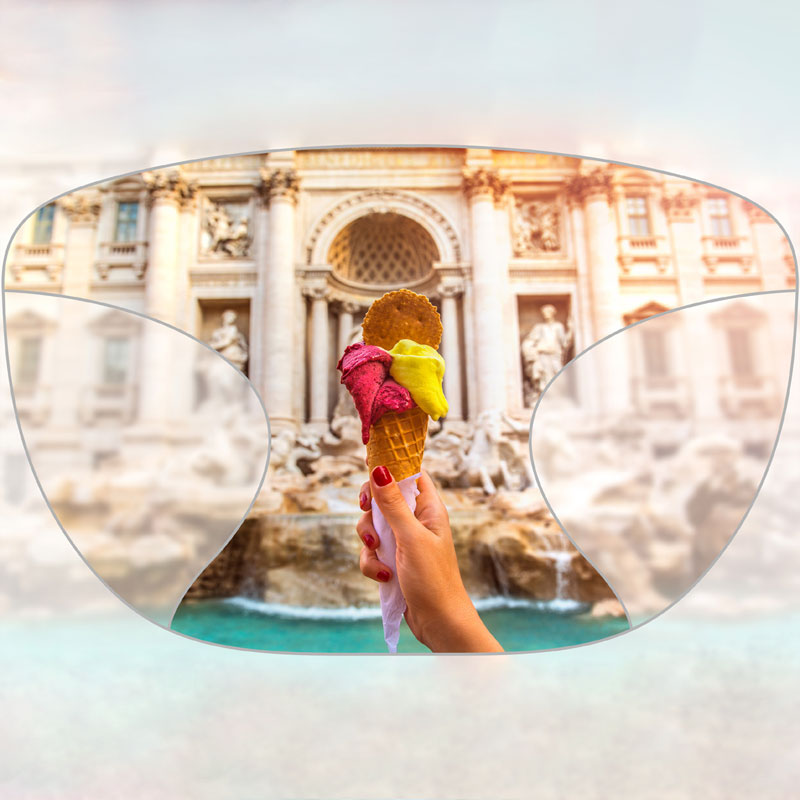 All Purpose Progressive LensUpdated design with additional featuresView Product →
An all-purpose progressive sits in the middle of that spectrum. It is designed to cover distance, desktop and reading without leaning too far towards any one of them, which is what most first-time wearers actually need. Pushing a wearer straight into a highly specialised corridor before they have any experience with progressive optics usually creates more problems than it solves.
Matching the Lens to the Day You Actually Live
The most common fitting mistake is treating progressive lenses as one product. They are a family of designs, and the right one depends on where the wearer spends their hours.
All-purpose daily wear
Balanced distance, intermediate and near zones. Suits commuting, shopping, television and general reading. The default recommendation for most first-time wearers.
Driving and outdoor use
A wider upper zone and a shorter, lower corridor. Designed so the wearer can scan mirrors, dashboard and road without hunting for the distance zone above the steering wheel.
Office and desk work
Shifted towards intermediate and near, typically covering roughly 40 centimetres to 2 metres. Excellent for dual monitors and paperwork, but not intended for walking or driving.
Young and first-time presbyopes
A softer add progression and a more forgiving peripheral design, which shortens the adaptation curve for people still adjusting to the idea of wearing glasses full time.
Relax and anti-fatigue designs
A small supporting add at the bottom of the lens for people whose accommodation is under pressure but who do not yet need a full reading prescription.
Myopia management designs
Peripheral defocus lenses for younger wearers, where the optical strategy is entirely different from presbyopia correction and should not be confused with it.
An office lens and a driving lens are both "progressive", but they solve opposite problems. A wearer who spends nine hours a day at a desk and then drives home needs to understand that one pair will not optimise both tasks equally well. In practice, most people accept a small compromise for convenience, and the all-purpose design handles that compromise better than either specialist option.
Where a dedicated occupational design earns its place
 Office Occupational LensAn excellent lens to wear while working at tasks requiring near and intermediate vision. The design has a wider field of view and more comfortable posture than a fully...View Product →
A desk-focused occupational lens removes the distance zone almost entirely and expands the intermediate and near areas instead. The result is a wider, flatter reading field with less head movement during long screen sessions, and a noticeably lower bending moment on the neck. For accountants, programmers, designers, lab technicians and anyone who measures their day in hours in front of a monitor, that trade is usually worth making.
Where a driving-oriented design earns its place
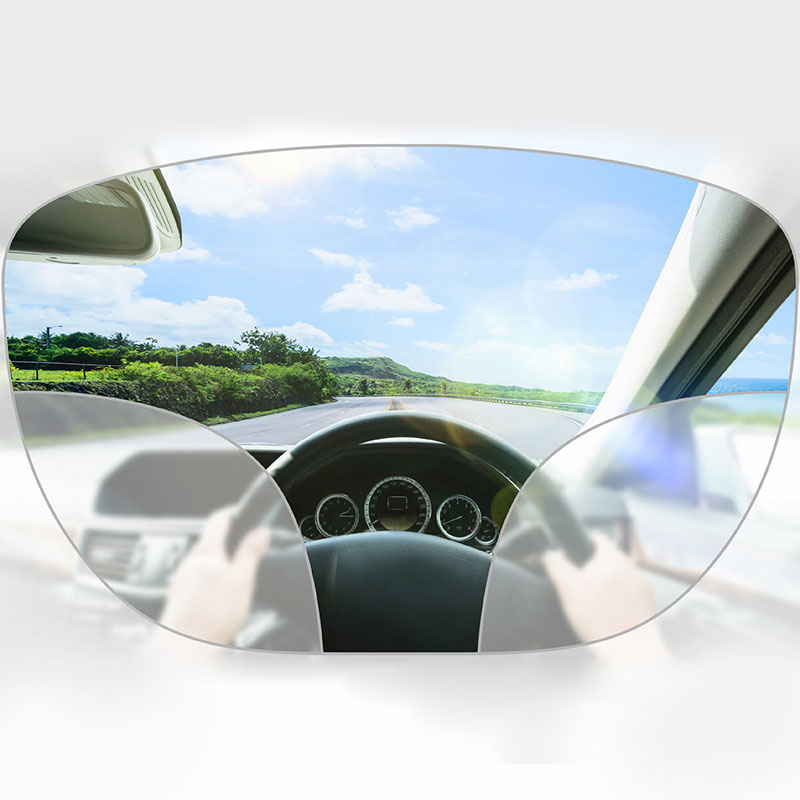 Driver Progressive LensThe Custom Driver is a progressive design that includes a wide distance area for comfortable viewing across the full width of the windscreen. The intermediate area is ...View Product →
A driving-oriented progressive keeps the distance zone generous and positions the intermediate corridor where the dashboard and navigation screen actually sit. It also reduces the amount of peripheral distortion in the lower outer corners, which is exactly where a driver glances when checking a side mirror. Wearers who report discomfort or uncertainty during night driving often find that the fix is not a higher index material but a differently positioned corridor.
Materials and Refractive Index: The Part Buyers Often Overlook
Choosing a 1.74 lens for a -1.00 prescription does not improve vision. It simply spends money. Conversely, choosing a 1.499 lens for a -7.00 prescription produces thick edges, a heavier frame, and magnified peripheral distortion that makes progressive adaptation harder.
| Material | Typical Abbe number | Relative thickness | Recommended for |
|---|---|---|---|
| 1.499 CR-39 type | Around 58 | Thickest | Prescriptions up to roughly ±2.00, budget orders, best colour fidelity |
| 1.56 mid-index | Around 38 to 40 | Moderate | Everyday prescriptions, good balance of price and cosmetics |
| 1.59 polycarbonate | Around 30 | Moderate | Impact resistance, sports, children, safety-oriented frames |
| 1.60 MR-type | Around 42 | Thin to moderate | Strong general-purpose choice, good optical clarity at higher powers |
| 1.67 high-index | Around 32 | Thin | Prescriptions above roughly -4.00, cosmetic improvement |
| 1.74 ultra-high-index | Around 33 | Thinnest | Prescriptions above roughly -6.00 where edge thickness dominates |
For progressive lenses specifically, the Abbe number matters more than it does for single-vision lenses. The blending zones already introduce prismatic and astigmatic effects at the edges of the lens, and a low Abbe number adds chromatic fringing on top of that. Wearers with high prescriptions who complain about colour fringes around streetlights and white text on dark screens are often feeling the material, not the design.
A representative mid-index progressive blank such as a 1.56 progressive lens with hard multi-coat covers the majority of everyday prescriptions while keeping thickness, weight and colour error within comfortable limits. Coating quality then becomes the next variable: a well-applied multilayer anti-reflective coating raises light transmission, cuts internal reflections and makes the corridor easier to read through, especially under office lighting.
A Fitting Checklist That Prevents Most Complaints
Progressive lens returns are expensive for everyone involved. Almost all of them trace back to a short list of measurable values, and every one of those values can be checked before the order leaves the bench.
- Measure monocular pupillary distance, not a single binocular figure. Half a millimetre per eye is visible in a progressive corridor.
- Record the fitting height from the lower lid or pupil centre, whichever method the design specifies, and repeat the measurement twice.
- Check frame vertical depth below the fitting cross. Anything under 18 millimetres is a warning sign.
- Confirm pantoscopic tilt and face form angle, then match them to the values used in the freeform calculation.
- Verify vertex distance and minimum fitting height quoted in the design's technical sheet.
- Correct the prescription for the working vertex distance if the power exceeds roughly ±4.00.
- Match the corridor length option to the frame depth: longer corridors need deeper frames.
- Explain head movement during the handover, and demonstrate that the reading zone sits low and slightly inward.
For buyers placing volume orders, three additional checks belong in the purchase specification: thickness tolerance across the ordered power range, coating adhesion and abrasion performance under a standardised test, and batch-to-batch consistency of the base curve. A progressive lens that performs well in a sample pair but drifts in the fifth batch creates a complaint pattern that no amount of staff training can fix.
Questions worth asking a supplier
- Is the progressive surface generated in-house on a CNC freeform line, or cast from a moulded blank?
- What is the stated corridor length range, and which frames does each option target?
- Which coating stacks are available on the progressive range, and what Abbe number does each substrate deliver?
- Can the design be personalised to fitting height, tilt and vertex distance?
- Are CE and FDA registrations current for the exact product being quoted?
- What is the documented tolerance on sphere, cylinder and axis for the finished pair?
Myths That Keep People Away From Progressive Lenses
Several beliefs circulate so widely that they shape purchasing decisions before a proper conversation ever happens.
- "Progressive lenses weaken your eyes." Correction does not weaken anything. The eye's focusing system changes with age regardless of what is worn, and a proper correction simply removes unnecessary strain.
- "There is a hidden line you can see." There is no line. There is a gradual power change, and the surface is cosmetically identical to a single-vision lens.
- "Progressives make everyone dizzy." A short adaptation period with mild peripheral swim is common. Persistent dizziness, nausea or double vision is not, and it points to a fitting or prescription error.
- "They are only for older people." Occupational and relax designs serve younger wearers whose near focusing system is under sustained pressure from screens, even before a formal reading add is required.
- "Expensive and cheap lenses are basically the same." Substrate and coating quality matter, but the design is what determines whether the corridor sits where the wearer's gaze actually goes.
Frequently Asked Questions
Can wearing progressive lenses damage my eyes over time?
No. There is no mechanism by which an accurately prescribed progressive lens harms ocular tissue. The lens changes how light enters the eye; it does not change the eye itself. Discomfort during wear is a fitting or adaptation issue, not damage.
Do progressive lenses help control myopia in children?
Standard progressive lenses are not a myopia control treatment. Myopia management uses different optical strategies, typically peripheral defocus designs, and it is a separate product category with its own evidence base. A progressive lens prescribed for a child without a specific defocus design should not be presented as slowing progression.
Are progressive lenses better for my eyes than bifocals?
For most wearers, yes, in terms of comfort. Bifocals create an image jump at the dividing line and cover only two distances. Progressive lenses cover all distances continuously and keep the distance zone clear across the full upper field, which matters for walking and driving. Bifocals remain a reasonable option for some specialised tasks and for wearers who genuinely cannot adapt.
Why does my screen look slightly soft with progressive lenses?
Monitors usually sit at 50 to 70 centimetres, which falls in the lower intermediate part of the corridor. If the corridor is long or the screen is low, the eye ends up looking through the transition between intermediate and near. The usual fixes are raising the monitor, shortening the corridor, or using a dedicated occupational design for desk work.
How long should adaptation take?
Most wearers feel comfortable within three to ten days of full-time wear. Two weeks is a reasonable outer limit for mild peripheral awareness. If vision is still unstable after four weeks, or if one eye is clearly worse, the lens position or prescription should be rechecked rather than tolerated.
Can I combine progressive lenses with blue light filtering or photochromic technology?
Yes. Photochromic progressive lenses and blue-filtering progressive lenses are both established products, and the combination is common for wearers who move between indoor screens and outdoor daylight. The main consideration is that some photochromic substrates and coatings slightly affect colour perception, so tint neutrality is worth confirming before a large order.
Should I buy progressive lenses online and have them fitted locally?
It can work, but the risk sits in the measurements. Fitting height, tilt and vertex distance depend on the frame as worn on the face. If those values are estimated rather than measured, the corridor will sit in the wrong place and no refund policy will make the lens comfortable.
How often should a progressive prescription be updated?
Every one to two years for most adults over 45, or sooner if reading distance has noticeably changed. The add typically increases gradually, and a small add change is far easier to adapt to than a jump of half a dioptre accumulated over four years.
Start with the frame, not the lens catalogue. Measure the vertical depth, decide where the wearer's eyes actually spend their hours, and choose a corridor that matches that reality. A mid-index freeform progressive fitted to a properly dimensioned frame will outperform a premium high-index lens squeezed into a shallow fashion frame every single time.
Then treat the handover as part of the product. Ten minutes spent explaining how to find the reading zone, how far to drop the chin, and how long the peripheral swim usually lasts prevents a large share of the "these lenses do not work for me" conversations that follow two weeks later. The lens is good for the eyes when the whole system around it is set up correctly, and that system includes the frame, the measurements, the coating and the wearer's understanding of what to expect.