

 Español


A myopia control lens is a prescription lens designed to do two jobs at once: provide clear central vision and change the way light reaches the peripheral retina. The first job is familiar to every optical professional. The second is what separates a control design from a standard single-vision lens, and it is the reason the category needs a different conversation at the dispensing counter and in the purchasing department.
For a child whose prescription is increasing year after year, the difference is practical. The family is not only asking for sharper distance vision. They are asking whether the next pair can help reduce the rate of progression, whether the child will tolerate the design, and whether the lens can be made consistently from one order to the next. Those questions involve optics, fitting, manufacturing tolerance, and follow-up.
The short answer is that myopia control lenses are most useful for children and teenagers with progressive myopia, especially when the prescription changes by about 0.50 D or more per year and the family can commit to regular reviews. They are not a cure, and they do not replace outdoor time, sensible reading distance, or professional eye care. They are one part of a management plan.
Core function
Correct central vision while adding a controlled defocus signal in the periphery.
Best candidates
Children and teens with progressing myopia, good wear compliance, and regular follow-up.
What to verify
Design range, optical zone size, add power, frame fit, coating, and batch consistency.
What Myopia Control Lenses Actually Do
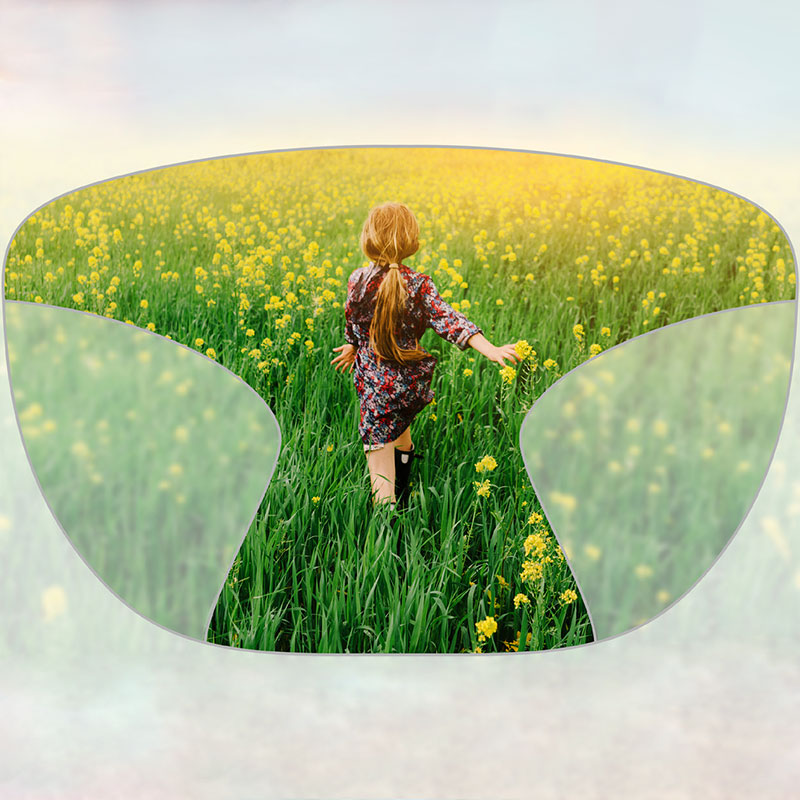
In a standard single-vision lens, the optical power is designed to place the image of a distant object on the central retina. That corrects blurred distance vision, but it does not address the peripheral image shell that many researchers associate with axial elongation. A control lens keeps the central zone clear while introducing a different optical treatment outside the center.
The treatment zone may be made of small lenslets, concentric rings, a peripheral aspheric curve, or a bifocal-style add. The exact geometry differs by design. The common principle is that the eye receives clear central vision and a controlled myopic or reduced hyperopic signal in the periphery. The intention is to reduce the stimulus for the eye to continue growing longer.
Clear center
The central zone supports distance vision, classroom work, and normal daily activity.
Treatment zone
Micro-segments, rings, or aspheric zones create the peripheral optical signal.
Follow-up
Regular reviews track prescription change, axial length where available, and tolerance.
It is not simply a stronger prescription
A common misunderstanding is that a control lens is just a higher-powered lens or a disguised bifocal. That is not accurate. The prescription still corrects the child’s refractive error. The control element is a separate optical feature. Two lenses can carry the same distance prescription and behave very differently because their peripheral treatment, optical zone size, and fitting requirements are not the same.
This is why a datasheet needs to be read as an optical specification, not only as a price list. The relevant questions are how large the clear central zone is, how the treatment is distributed, what add power or defocus level is used, and whether the design has a minimum or maximum prescription range. A lens that works well at -2.00 D may not be available or suitable at -8.00 D with high astigmatism.
The Main Optical Designs Used in Myopia Control
Most spectacle-based control designs fall into a few practical families. The names used by manufacturers vary, but the optical logic is usually recognizable. A buying team should compare the families by function rather than by marketing language alone.
Multi-segment designs place many small treatment zones around a clear center. Lenslet-array designs use tiny raised or embedded optical elements to create a defocus pattern. Peripheral aspheric designs change the curvature outside the central zone. Bifocal and progressive-based designs use an add power to reduce near demand and alter the peripheral image shell. Each approach has different implications for cosmetics, adaptation, frame choice, and prescription range.
| Design family | How treatment is created | Practical fitting note |
|---|---|---|
| Multi-segment defocus | Small treatment segments surround a clear central zone. | Centration and frame stability matter; a slipping frame weakens the intended effect. |
| Lenslet array | Tiny optical elements create a controlled treatment pattern. | Check the visible treatment zone, minimum fitting height, and cosmetic acceptance. |
| Peripheral aspheric | Curvature changes outside the center create a peripheral signal. | Less dependent on a visible segment pattern, but sensitive to vertex distance and tilt. |
| Bifocal or progressive based | An add power reduces near demand and modifies the peripheral image shell. | Useful when near posture or accommodation is part of the clinical picture. |
| Concentric treatment rings | Alternating zones create a repeated defocus structure around the center. | Confirm the clear zone diameter and how the design behaves across the prescription range. |
 Octagonal Circular Myopia Control LensA pediatric myopia-control lens with 864 micro lenses across nine circles, offering graded peripheral defocus and a defined central vision area.View Product →
For teams that need a spectacle option with a defined treatment geometry, the octagonal and circular myopia control lens range is a useful reference point. The important comparison is not only the name of the pattern. It is the clear zone, the treatment distribution, the available power range, and the consistency of the surfaced lens.
One more point deserves attention: the treatment zone must survive the entire manufacturing process. Surfacing, polishing, coating, and edging can all affect the final optical result if the process is not controlled. A design that looks good on a drawing but loses precision during production will not deliver a reliable fitting experience.
Who They Are For and Who They Are Not For
Myopia control spectacle lenses are generally intended for children and teenagers whose myopia is still progressing. Many designs are aimed at younger wearers, often from about six years old, but age alone is not the deciding factor. The clinical picture, prescription range, binocular vision, and family history all matter.
A strong candidate is a child with a steadily increasing prescription, a clear willingness to wear the glasses during school and outdoor activity, and parents who can attend follow-up appointments. A child who only wears glasses occasionally, or whose frame is constantly sliding down the nose, is unlikely to get the intended benefit from any design that depends on stable centration.
Often suitable
- Children or teens with documented progression
- Prescriptions within the design’s published range
- Families who accept regular review appointments
- Wearers who can keep the frame properly positioned
- Patients without contraindications identified by their eye care professional
Needs closer review
- Very young children outside the design’s intended age range
- High astigmatism or prism requirements beyond the available range
- Strabismus, amblyopia, or binocular vision concerns
- Children who cannot tolerate peripheral awareness changes
- Families expecting a guaranteed stop in progression
Adults with stable myopia are usually not the primary group for control lenses. The goal for an adult is normally clear, comfortable vision and appropriate correction of refractive error. A control design may still be discussed in specific cases, but the decision belongs with the eye care professional who can assess the full clinical context.
Prescription and Fitting Data That Change the Result
A control lens is only as good as the data used to make it. The prescription is the starting point, but it is not the whole order. Fitting height, pupillary distance, frame shape, vertex distance, pantoscopic tilt, and reading add can all influence how the patient experiences the design. Small errors that are tolerable in a standard single-vision lens can be more noticeable in a lens with a structured treatment zone.
For a child, frame choice is not a cosmetic afterthought. A frame that sits too low, slides forward, or has a very shallow eye size can reduce the usable treatment area. A frame that is too wide can increase decentration. The best frame is stable, comfortable, and sized so the optical center can be placed correctly without pushing the treatment zone into the wrong part of the lens.
| Data point | Why it matters | What to confirm |
|---|---|---|
| Distance prescription | Corrects the child’s refractive error. | Sphere, cylinder, axis, and any prism are within the design range. |
| Add power or defocus level | Defines the treatment strength or near support. | The selected value is appropriate for the design and clinical need. |
| Pupillary distance | Positions the clear center over the pupil. | Monocular PD is recorded, especially for children and asymmetric faces. |
| Fitting height | Keeps the treatment zone in the intended position. | The frame has enough depth and the height is measured in the final frame. |
| Frame stability | Prevents slipping and decentration during daily wear. | Nose pads, temple fit, and weight are suitable for the child’s activity level. |
| Coating and material | Affects durability, clarity, and safety. | The coating is compatible with the design and the material suits the wearer. |
It also helps to record what the lens is expected to do. Is the primary concern progression, near comfort, or both? Is the child screen-heavy, outdoor-active, or sensitive to peripheral blur? These notes make the follow-up visit more productive because the practitioner can compare the original intention with the actual experience.
Real-World Performance: Adaptation, Vision, and Daily Use
Most children adapt to a control design within days, but the first week can include reports of peripheral awareness, slight blur when looking to the side, or a different feeling when walking downstairs. These comments should be taken seriously without being treated as automatic failure. The fitting professional needs to distinguish normal adaptation from poor centration, an unsuitable frame, or a prescription issue.
Clear central vision usually feels normal quickly. Near comfort depends on the design and the child’s accommodation. Peripheral awareness changes are often the most noticeable part of the first few days. If the child is constantly pushing the glasses up, tilting the head, or avoiding the lenses for reading, the frame and fitting data should be checked before assuming the design is unsuitable.
The chart is an illustrative comparison of common fitting priorities. It is not clinical trial data and should not be used as a performance guarantee.
For school and screen use, a robust material and a suitable coating can make daily wear easier. Some children need impact resistance and blue-light filtering but are not candidates for a control design. In that situation, a 1.59 polycarbonate blue-block progressive can be a practical everyday option. It is not a progression-control lens, and it should not be presented as one.
Sports and outdoor play deserve a separate check. Polycarbonate or other impact-resistant materials are often preferred for active children. If the control lens is made in a material that is not appropriate for the child’s activities, the family may need a second pair for sport. That is not a failure of the control design; it is a practical eyewear plan.
How Myopia Control Lenses Compare with Other Options
Spectacle-based control is one route among several. It is non-invasive, reversible, and relatively easy for a child to manage. Contact lens options and atropine require different levels of clinical monitoring and are not interchangeable with glasses. The right choice depends on the child’s age, prescription, tolerance, family preference, and the availability of follow-up care.
Standard single-vision glasses correct blur but are not designed to slow progression. Bifocal or progressive glasses may help some children with near posture or accommodative issues, but not every add design is a control design. This distinction matters at the point of sale: a parent who hears “progressive” may assume it is the same as “myopia control,” and that confusion can damage trust.
| Option | Main purpose | Practical consideration |
|---|---|---|
| Standard single-vision glasses | Correct distance blur. | Simple and familiar, but not designed for progression control. |
| Myopia control spectacles | Correct vision and add a peripheral treatment signal. | Non-invasive; fitting accuracy and daily wear are essential. |
| Bifocal or progressive spectacles | Support near vision and reduce accommodative demand. | Depends on the design and clinical need; not automatically a control lens. |
| Soft contact lenses for control | Correct vision and deliver a controlled optical effect. | Requires hygiene, handling confidence, and clinical monitoring. |
| Orthokeratology | Reshape the cornea overnight for daytime vision. | Requires careful fitting, cleaning routines, and regular reviews. |
| Low-dose atropine | Medication-based management under professional care. | Availability and protocols vary by market; follow local regulation. |
For many families, spectacles are the first option because they are familiar and easy to remove. For others, contact lenses or medication may be recommended. The decision should not be driven by a single visit or a single product listing. It should be based on the child’s progression history, eye health, lifestyle, and the practitioner’s judgment.
Manufacturing Details That Affect Lens Consistency
Control lenses are often discussed as if the design alone determines the outcome. In practice, manufacturing discipline matters just as much. A freeform surface must be generated accurately, the treatment geometry must remain centered, and the coating must not distort the optical result. If those steps are inconsistent, the practitioner may see variable adaptation even when the prescription and fitting data look correct.
A vertically integrated production line helps control the handoffs between design, mold development, cutting, polishing, coating, inspection, and packing. Green Stone’s production process covers these stages in-house, which supports repeatability across orders. That does not replace clinical fitting, but it reduces the risk of a good design being undermined by a loose manufacturing process.
Peripheral defocus is not a cosmetic feature. It is a geometry that has to survive surfacing and coating. For a deeper technical view, this explainer on why peripheral defocus matters for lens efficacy is useful for teams that need to explain the concept to clients.
Production checks that support a reliable control lens
- Treatment zone centered and verified after surfacing
- Power and cylinder within the published tolerance
- Coating adhesion and clarity checked on the finished lens
- Edge thickness and mounting compatibility reviewed for the chosen frame
- Batch traceability from semifinished blank to packed order
Buyers should also ask how the supplier handles remakes and how fitting-related returns are separated from manufacturing defects. A lens can be made correctly and still fail clinically because the frame slipped or the fitting height was wrong. Clear communication between the optical lab, the practitioner, and the supplier shortens the correction cycle and protects the family’s confidence.
Choosing the Right Lens for a Child or Teen
The starting point is not the product name. It is the child’s progression history and daily routine. A child who spends most of the day in a classroom, reads at close distance, and plays outdoor sports has different needs from a child who is highly screen-focused or has a strong family history of high myopia. The lens choice should reflect those realities.
After the clinical recommendation, check the practical fit. Is the frame deep enough for the design? Is the material appropriate for the child’s activity? Does the coating resist smudging and scratching without reducing clarity? Can the family return for follow-up at the recommended interval? These questions are more useful than comparing two lenses only by their marketing names.
 Junior Soft Progressive Lens for Younger WearersA custom progressive lens for younger wearers, featuring a 13 mm corridor, +1.50D to +2.00D adds, and stable reading with distance peripheral clarity.View Product →
Some younger wearers need a gentler progressive corridor rather than a dedicated control design. A junior soft progressive can reduce adaptation complaints and support comfortable near vision, but it should be positioned honestly. It is a lifestyle and comfort option, not a substitute for a clinically selected myopia control lens.
Order review before production
- Confirm the design’s age and prescription range.
- Check monocular PD and fitting height in the final frame.
- Review frame stability and likely wearing position.
- Match material and coating to the child’s daily activity.
- Record the follow-up interval and the baseline measurements.
- Explain what the lens can and cannot do before the family orders.
Clear expectations are part of the product experience. A family that understands the purpose of the treatment zone, the reason for follow-up, and the difference between correction and control is more likely to stay consistent with wear. That consistency is often more valuable than a small difference in headline specification.
Frequently Asked Questions
Are myopia control lenses just bifocals?
No. Some control designs use bifocal or progressive-style add power, but a standard bifocal is not automatically a control lens. The defining feature is the peripheral treatment geometry and the clinical intention behind it. A bifocal may help near vision, while a control lens is designed to influence the peripheral optical signal associated with progression.
At what age can a child start wearing them?
Many designs are intended for children from around six years old, but the correct starting point is a clinical assessment, not a fixed age on a box. The practitioner will consider the prescription, progression history, binocular vision, and the child’s ability to wear and handle glasses. Younger children may need a different management route or closer supervision.
How quickly will the prescription stop changing?
There is no guaranteed stop point. The aim is to reduce the rate of progression, not to freeze the eye. Some children show little change over a year; others continue to progress more slowly. Regular reviews are needed to compare prescription change, axial length where available, and visual comfort. Families should be told this before they buy.
Do control lenses make the eyes dependent on glasses?
A child who is myopic already needs correction to see clearly at distance. The control design does not create a new dependency in the way some parents fear. It adds a treatment feature to a prescription that is already necessary. The more relevant issue is whether the child wears the glasses consistently enough for the design to work as intended.
Can adults use myopia control lenses?
Adults with stable myopia are usually fitted for standard vision correction rather than progression control. There may be specific clinical situations where a control design is discussed, but the decision should be made by an eye care professional. Adult patients should not assume that a control lens will reverse existing myopia or eliminate the need for glasses.
What should a supplier datasheet include?
A useful datasheet should state the available prescription range, add power or defocus options, clear zone size, minimum fitting height, recommended frame type, material options, coating compatibility, and any fitting restrictions. It should also explain how the treatment zone is positioned. Without those details, a buyer is comparing prices without comparing the actual product.
Are these lenses suitable for high astigmatism?
It depends on the design. Some control lenses have limited cylinder ranges, and high astigmatism may reduce the usable treatment area or require a different approach. The prescription should be checked against the manufacturer’s published range before the order is placed. A lens that is available in the right power but outside the design’s intended fitting envelope is not a safe substitution.